Safety decking vs crash decking — what's the difference?
Safety decking prevents a fall. Crash decking arrests one. They are different categories of product, and the wrong one on your CDM file is a real problem.
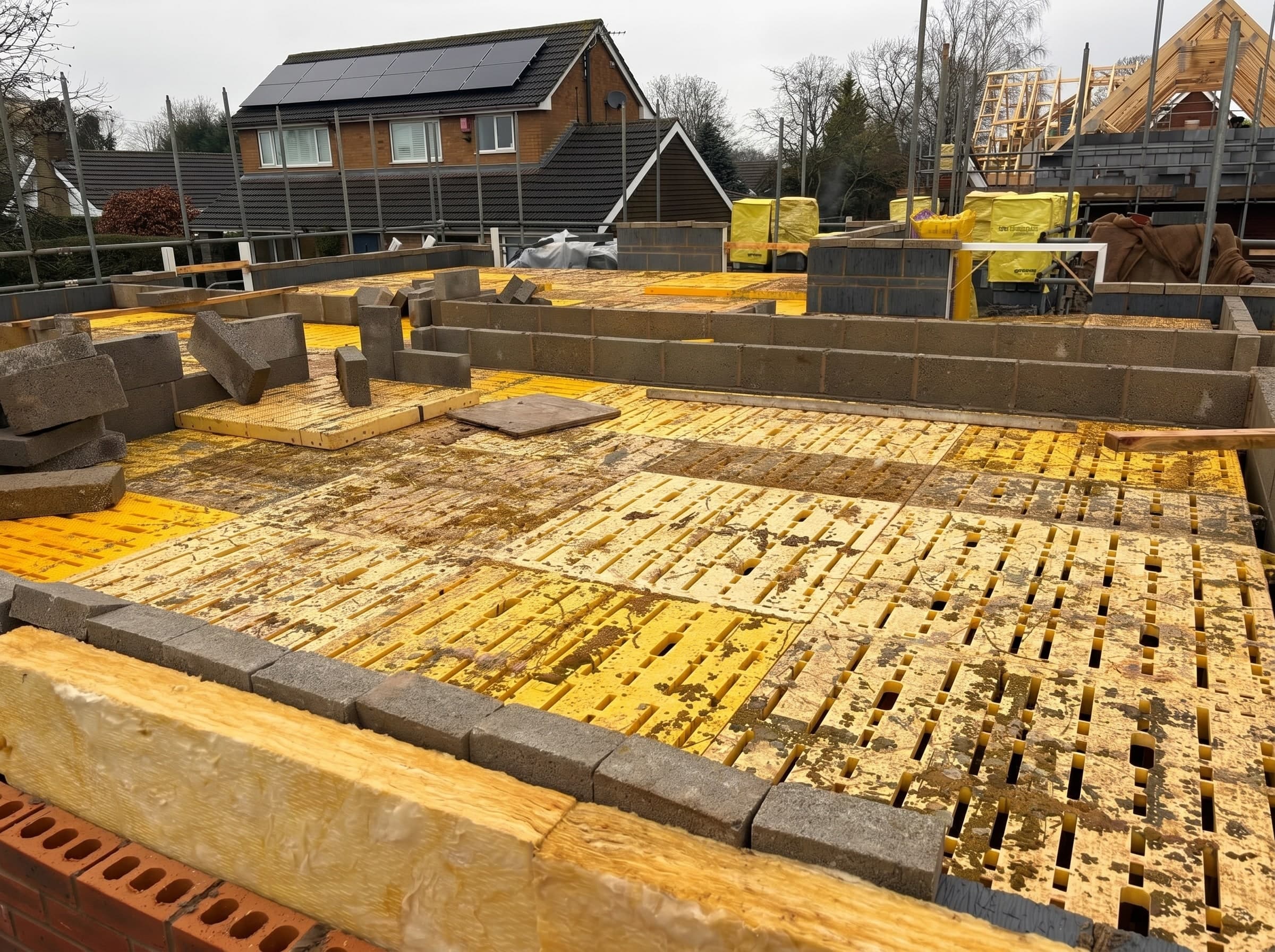
Safety decking is a working platform that prevents a fall. Crash decking is an energy-absorbing system that arrests one. They are not interchangeable, and the wrong one on your CDM file is a real problem — so it is worth getting the words right before the first quote goes out.
The two words get used interchangeably. They should not be.
In day-to-day site language, "crash deck" gets used as a catch-all for any horizontal protection underneath a working area. That is the source of most of the confusion. The two systems do completely different jobs, are tested against completely different standards, and end up on completely different lines of a method statement.
If a principal designer is building a CDM file and the wrong category of product is named on it, the file does not match the install — and the person who notices is usually an insurer, after something has already gone wrong. The distinction is not pedantic. It is the difference between a platform you walk on every day and a system that exists to catch a falling person who should not have fallen in the first place.
What "safety decking" actually means
Safety decking is a fall-prevention working platform. It is a continuous, walkable surface installed across a floor opening — typically at first-floor level on a housebuilding plot, across a stair void on an apartment frame, or below an open ceiling void on a care-home block — so that the trades working above the deck are working over a solid surface rather than over an open drop.
The job of a safety deck is to mean a fall does not happen. Operatives stand on it. Materials are stored on it within its rated load. It is inspected before it goes into service, inspected daily by visual check, inspected weekly under a documented regime, and re-inspected after any impact, alteration or adverse weather event.
Trad Deck — the system Graceland installs across most UK housebuilding, care-home and apartment work — is a fall-prevention platform of this type. The TRAD Safety Deck user guide is unambiguous: "TRAD SAFETY DECK IS NOT A CRASH DECK". It is rated to Load Class 3 under BS EN 12811-1:2003, with a safe working load of 2.0 kN/m² uniformly distributed (inclusive of operatives) and Class B material fragility under ACR[M]001:2014. Those numbers describe a working platform, not an arrest system.
What "crash decking" actually means
A crash deck — sometimes called a fall-arrest deck or an energy-absorbing deck — is a different category of product entirely. Its job is to absorb the kinetic energy of a person who has already fallen, in the moments after the fall has begun, and bring them to rest without injury. Fall-arrest systems include energy-absorbing panel decks, fall-arrest netting installed below a working area, and airbag systems used on certain demolition and refurb jobs.
These systems are tested under different standards (because what matters is dynamic energy absorption, not static load capacity), they are deployed in different geometries (typically below the area where work is happening, not on the floor where work is happening), and they do not double up as working platforms. You do not stand on a fall-arrest net to do your job. You install one because you have decided that some residual fall risk above it cannot be designed out and you need a last line of defence.
When you actually need fall arrest
Fall arrest — crash decks, fall-arrest netting, airbag systems — is the right answer in a narrow set of situations. Steel-frame erection at height where you genuinely cannot put a continuous walking surface across the work zone. Demolition and certain refurb contexts where temporary openings are appearing and disappearing too fast for a safety deck pattern to keep up. Roof work above an unprotected void where a fall-prevention measure is not physically possible.
In those situations, fall arrest is not a worse option — it is the right option. We are not in that business; specialist netting and airbag contractors are, and any honest safety decking installer will tell you that on a survey if it is what your job needs.
When you need fall prevention (which is most of the time)
Fall prevention — a safety deck — is the right answer in the much larger set of situations where the geometry allows a continuous walkable platform. Housebuilding plots with regular first-floor openings. Apartment frames with repeatable bay patterns floor by floor. Care-home blocks with ceiling voids that need protection through a long fix-out window. Commercial steel-framed buildings with long-span bays where the deck doubles as a working platform for the trades above.
In every one of those situations, what your principal designer needs on the CDM file is a fall-prevention platform with a documented load rating, a documented inspection regime, and a Handover Certificate that says the platform is in service. That is what a safety deck install delivers. A crash deck does not deliver any of those things, because it is not the same product.
Why the wrong word on the wrong file is a real problem
If "crash deck" is written into a method statement and what shows up on site is a safety deck, the documentation does not match the install — and vice versa. On most jobs nobody notices, because the on-site team understands what they actually need and uses the right product anyway. But on the jobs where it does get noticed, it is usually because something has gone wrong, and the insurer, principal designer or HSE inspector is looking at the paperwork to understand what happened.
The simplest fix is the one the surveyor should be insisting on at quote stage: the word in the method statement matches the product being installed. If the product is a fall-prevention platform, the method statement says fall-prevention platform. If the product is a fall-arrest system, it says fall-arrest system. No catch-all "crash deck" language in either case.
A real example from a survey
We were asked to quote for a "crash deck" on a small care-home extension last year. The phrase was on the principal contractor's enquiry email, on the draft method statement and on the spec sheet that came back from their client. On the survey it was very clear what the job actually needed: a continuous fall-prevention platform across the first-floor void for the duration of the M&E first fix and ceiling close-up, then a planned dismantle. That is a Trad Deck install, top to bottom. There was no fall-arrest requirement anywhere on the job.
We installed it as a safety deck and made sure the documentation that ended up on the CDM file said fall-prevention platform, Trad Deck, Load Class 3 to BS EN 12811-1:2003. Not "crash deck". Not because it is a sales line, but because two years later when somebody picks up that file, they should be able to read what was actually on the floor. Words on paperwork are part of the install.
What to ask for, by job type
If your job is housebuilding, care-home, apartment-frame or most commercial steel-framed work, what you almost certainly need is a safety deck — a fall-prevention working platform. Ask for a survey, ask for a Handover Certificate, ask for the system's Load Class and SWL. That is what a Graceland survey delivers.
If your job genuinely involves a residual fall risk above an area where a continuous walking platform is not physically possible — and your principal designer has signed off that fall arrest is the appropriate measure — what you need is a fall-arrest contractor, not us. We will tell you that on the phone.
If you are not sure which one your job is, that is exactly what a survey is for. Phone Paul or Ewan and describe the geometry. The honest answer might be Trad Deck, it might be G-Deck, it might be "you actually need fall arrest, here is who to call". All three of those are valid outcomes of a survey conversation.
Further reading
- Safety deck loadings explained
- Safety decking vs scaffolding birdcage
- Trad Deck system page
- Accreditations and standards
Send us the project details and we will identify the category of product your job needs
Every article here is written by the crew that surveys, installs and dismantles the deck — not a marketing desk.
If you want this applied to a real site rather than read in the abstract, a phone call to Paul or Ewan is faster than any form.
Keep reading
Safety Deck Loadings Explained
Safety deck loadings explainedSafety Decking Vs Scaffolding Birdcage
Safety decking vs scaffolding birdcageTrad Deck installation
Trad Deck fall-prevention platform quoted and installed by Graceland. Load Class 3 to BS EN 12811-1:2003. SWL 2.0kN/m² UDL. Class B material fragility.
Systems / Trad deckAccreditations and standards
FASET audited for platform decking installation and SMAS Worksafe SSIP approved, both renewed for 2026–27. Our certificates, what they cover and how to check them.
About / AccreditationsSite survey
Safety decking site surveys where needed. Send Graceland your drawings and project details first; most jobs can be assessed and quoted without a visit.
Services / Site survey