
Trad Deck vs G-Deck Lite — which to choose
Trad Deck and G-Deck Lite both carry 2.0 kN/m². Compare plastic impact absorption with lightweight steel speed, rigidity and site efficiency.
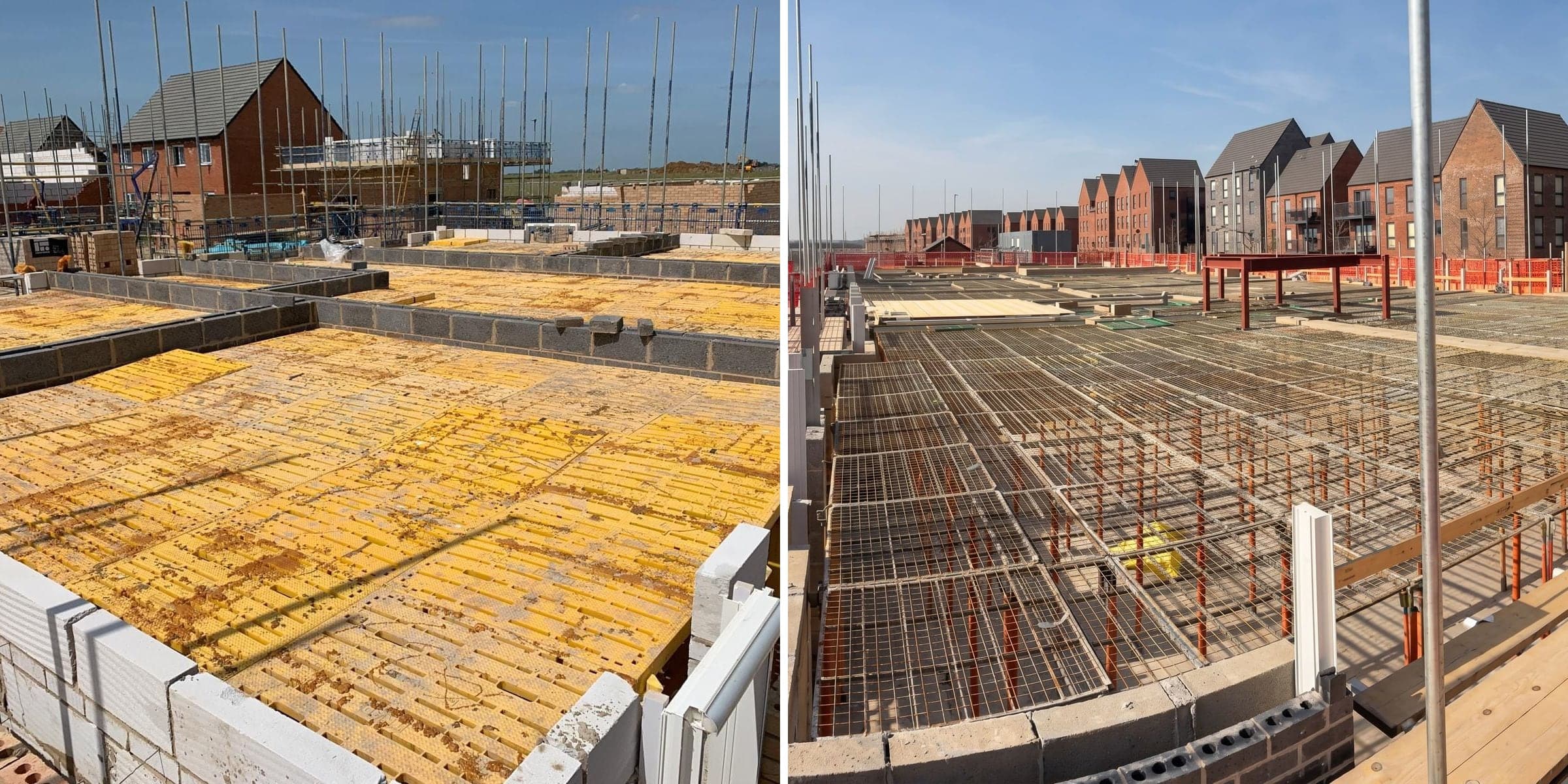
Trad Deck is the familiar answer on many UK housebuilding, care-home and apartment jobs. G-Deck Lite is a lightweight steel alternative for suitable areas where fast handling, rigidity and whole-area efficiency matter. Both have a published 2.0 kN/m² safe working load, so the decision is about the project rather than a claim that Lite carries three times more.
Why this is a project decision, not a product page decision
We install both systems and have no commercial reason to push one over the other. Send us the drawings, programme and site details first. We can normally assess the area on paper, and arrange a site survey only when geometry, levels or access need checking in person.
What this article does is explain the practical questions behind that recommendation, so the comparison is based on the installed job rather than a brochure headline.
Trad Deck — the housebuilding default
Trad Deck is the system most UK housebuilding, care-home and standard commercial work runs on. It is a polypropylene panel system installed across leg units and base units to form a continuous fall-prevention working platform across a floor opening. Panels come in three standard sizes and leg units in three standard heights, which is the reason a Trad Deck install pattern repeats cleanly across plot after plot of the same house type.
The published specs for Trad Deck are well-documented and well-understood across the supply chain. It is rated to Load Class 3 under BS EN 12811-1:2003, with a safe working load of 2.0 kN/m² uniformly distributed (inclusive of operatives on the deck) and Class B material fragility under ACR[M]001:2014. The user guide is explicit that it is a fall-prevention platform — not a crash deck — and that constant impact from heights above 500 mm weakens the panels and triggers a fresh inspection.
For a Graceland surveyor, Trad Deck is the default starting position on any housebuilding plot, any care-home block, any apartment frame with regular bays, and any commercial floor plate where the bays sit comfortably inside the standard panel and leg dimensions. If nothing on the survey rules it out, that is what you are getting.
G-Deck Lite — lightweight steel built for speed
G-Deck Lite is a lightweight steel mesh safety decking system for work-on and walk-on applications where heavy load-bearing capacity is not required. Its low-profile components are designed to be easy to handle and quick to position, helping the deck go in faster so the trades above can keep moving.
In practice, Graceland considers Lite where steel rigidity, manoeuvrability, fast installation or cost efficiency across a suitable area outweigh Trad Deck's advantages. Large stock held across depots in Cambridgeshire and Derby also helps us mobilise the system without holding up the programme.
The published Lite figures are clear: 2.0 kN/m² UDL — 200 kg/m², erected up to 3.0m, with adjustable-height leg, integral handrail, self-closing gate and cross-bracing options. The manufacturer lists BS EN 12811-1:2003, BS EN 13374:2013 Barrier Class A and BS EN 12811-2:2004 materials grade, and reports a drop test of 100 kg from 2m.
Set that against Trad Deck's 2.0 kN/m² UDL and the distinction is not higher loading. Lite's case is fast, lightweight steel handling and rigidity; Trad Deck's is familiar plastic panel performance, repeatable patterns and impact-absorption characteristics.
One thing not to confuse: G-Deck's Barrier Class A is a BS EN 13374 edge-protection classification, and Trad Deck's Class B is an ACR[M]001:2014 material-fragility classification. They sound comparable and are not — different standards measuring different things. Neither figure transfers to the other system.
How the decision actually gets made
The team assessing your drawings is asking three questions in this order.
Do the bays repeat? If the geometry is regular and a pattern can be built that works for every bay (or every plot, or every floor), Trad Deck is almost always the right answer. Pattern repetition is where Trad Deck's economics live — the second plot is faster than the first, the third is faster than the second, and the dismantle is a single planned visit.
How quickly does the area need to be released? Lite's lightweight, slim components are built for quick handling and installation, which can make it the efficient answer where follow-on trades need access without delay.
Which system fits the area and access constraints cleanly? Panel handling, internal access, gates, handrails, bracing and the installation sequence all affect the answer. If the drawings leave those points unclear, that is when a site survey earns its place.
Once we have the information we need, the answer is usually clear and the recommendation forms part of the written quote.
Which one ends up on the Handover Certificate
Whichever system goes in, the Handover Certificate will name it explicitly, with its load class, its inspection regime and its supporting documentation. We do not put "safety deck" on the certificate as a generic term — your CDM file should be able to tell you, two years later, whether the platform on plot 47 was Trad Deck or G-Deck and what its rated SWL was. That is the level of documentation we hand over either way.
A real example
On mixed projects the right answer can still be two systems: Trad Deck on repeatable plots or regular bays, and G-Deck Lite across a suitable area where fast steel installation improves the sequence. Both can be installed by the same qualified crew in one mobilisation and identified clearly on the Handover Certificate.
That is why the recommendation is made for the real project rather than every customer. The right answer for your site may be one system or both, and most of that assessment can start from the drawings.
Further reading
- Safety decking vs crash decking
- Safety deck loadings explained
- Trad Deck system page
- G-Deck system page
Send us the drawings and we will recommend the right system for your bays
Every article here is written by the crew that surveys, installs and dismantles the deck — not a marketing desk.
If you want this applied to a real site rather than read in the abstract, a phone call to Paul or Ewan is faster than any form.
Keep reading
Safety Decking Vs Crash Decking
Safety decking vs crash deckingSafety Deck Loadings Explained
Safety deck loadings explainedTrad Deck installation
Trad Deck fall-prevention platform quoted and installed by Graceland. Load Class 3 to BS EN 12811-1:2003. SWL 2.0kN/m² UDL. Class B material fragility.
Systems / Trad deckG-Deck Lite installation
G-Deck Lite steel safety decking, installed nationwide from Graceland depots in Cambridgeshire and Derby. Lightweight, fast and rated to 2.0 kN/m².
Systems / G deckSite survey
Safety decking site surveys where needed. Send Graceland your drawings and project details first; most jobs can be assessed and quoted without a visit.
Services / Site survey